Dunfermline Abbey (the Nave)
Abbey · 40 m away
The ruined royal palace that grew from the abbey guesthouse; Charles I was born here in 1600.
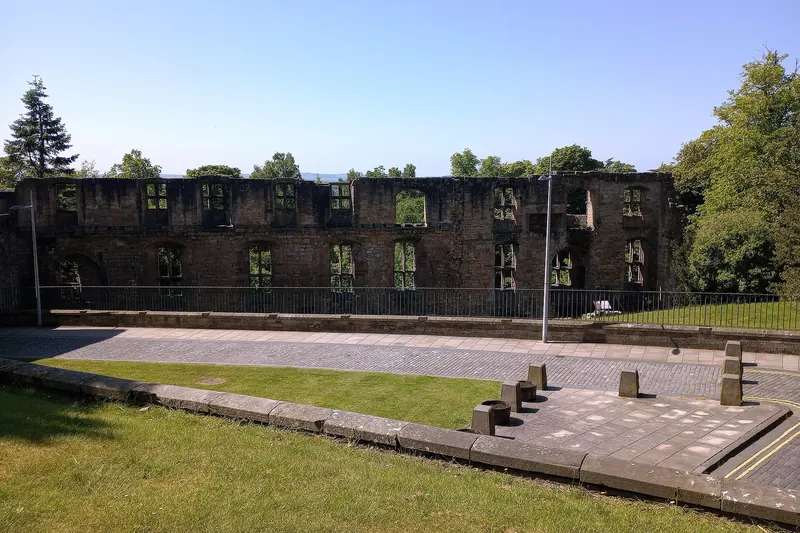
Even if you can’t walk through it today, you’ll want to see Dunfermline Palace. The ruined royal residence hangs over the east side of Pittencrieff Park, and Historic Environment Scotland says the ruins, though closed for conservation work, can be seen from street level. Fife Council’s park pages make the same point from below: if you’re in the lower glen, stop and look up. This is where Charles I, the last monarch born in Scotland, came into the world in 1600.
The palace grew out of the abbey, rather than sitting apart from it. Medieval abbeys usually had several grades of accommodation, and Historic Environment Scotland says the guesthouse was probably a royal residence from the start. The official history and the scheduling describe how, after the Reformation of 1560, a new palace was created from that guesthouse and the west range of the abbey. The core of the guesthouse is of similar date to the refectory, rebuilt around 1329; the range was probably altered and extended around 1500 for James IV, remodelled later in the 16th century for James V, and around 1589 adapted as a palace for James VI’s queen, Anna of Denmark. Historic Environment Scotland’s visit page puts it simply: she created an imposing palace with the monastic guesthouse at its heart, and it became her personal residence.
Royal interest did not last long after the Union of the Crowns. Historic Environment Scotland records that James and Anna left for London in 1603, and that the palace then fell into disrepair. What you see now is part of a much larger scheduled monument that also takes in the monks’ refectory, the dormitory and latrine ranges, the 15th-century gatehouse over the old precinct entrance, and the kitchen. The south and west walls of the refectory still stand to full height. Below, on ground sloping down to the Tower Burn, the scheduling includes remains associated with the mill lade known as the Lead — three mills in existence by the 16th century, using watercourses created for the abbey, and potentially on the site of the abbey’s own mills. To the west of the abbey is the site of the 17th-century Queen’s House.
It’s easy to confuse the palace with the church above it, so it helps to keep the two visits distinct. The nave and Abbey Church are the buildings you enter; the palace is the ruined range on the slope overlooking the park. Historic Environment Scotland’s plan-your-visit page says the palace ruins are closed while conservation works are ongoing, and that the rest of the abbey is open to explore. That status can change, so check the official page before you go rather than assuming you can walk the ruins. You can still take in the façade from St Margaret’s Street and from Pittencrieff Park, where the inventory of designed landscapes calls it a prominent feature from the glen.
Practicalities follow the abbey’s. The wider site is at St Margaret’s Street, KY12 7PE, in the Heritage Quarter, about 0.2 miles from the bus station and 0.5 miles from Dunfermline City station. Historic Environment Scotland looks after the abbey and palace together; entry to the open parts of the site is free, with donations welcome. Seasonal hours, last entry and the Christmas to early January closure are published on the plan-your-visit page, and the Abbey Church’s hours can change for services. There’s no visitor car park and no toilets on the monument itself. If you’re approaching from the park, Fife Council notes entrances from St Margaret’s Street and Moodie Street that lead into the lower glen along the Tower Burn — a good place to see the palace from below, then walk up to the abbey when it’s open.
Abbey · 40 m away
Parish Church · 60 m away
Townhouse · 130 m away
Library · 150 m away
Local updates, service changes and what’s on — for people who live here, work here or are just visiting. Unsubscribe anytime.