Dunfermline Abbey (the Nave)
Abbey · 40 m away
William Burn’s Gothic Revival parish church of 1818–21, built over the abbey’s choir, with ‘King Robert the Bruce’ spelled out round its tower.
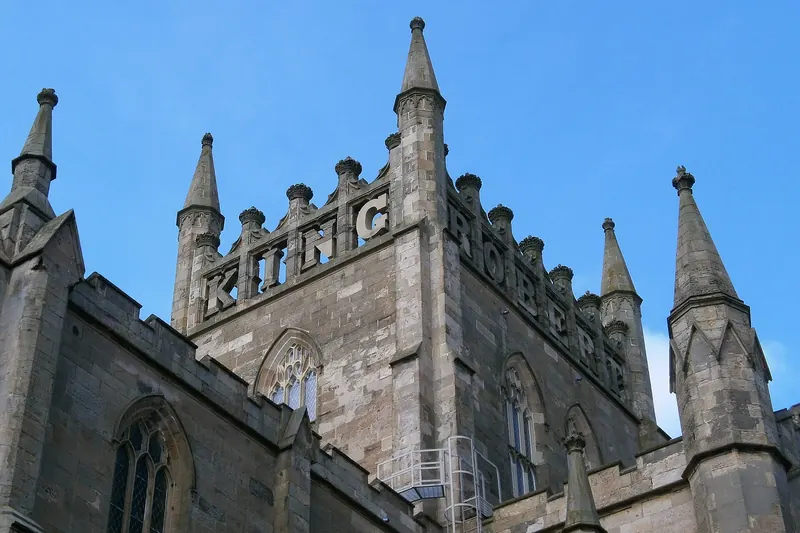
If you’ve come to stand at the burial place of Robert the Bruce, this is the building you actually walk into. Dunfermline Abbey Church is the parish church of 1818–21, designed by William Burn and built over the abbey’s ruined choir and transepts, immediately east of the Romanesque nave. Historic Environment Scotland describes those earlier choir and crossing as the most important of Scotland’s royal burial places. The church’s own site calls it, after Iona, the principal royal mausoleum in Scotland. It’s a working Church of Scotland church as well as a visitor site, which is worth remembering before you plan a flying visit.
From the outside, the thing you’ll notice first is the crossing tower. Around its top, in open stonework, are the words “KING ROBERT THE BRUCE”. Historic Environment Scotland thinks that lettering derives from Hill House, a 17th-century laird’s house on Limekilns Road. The church’s own history is more specific about why the tower looks as it does: during foundation work in 1818 the tomb of Robert I, buried here in 1329, was rediscovered; the remains were reinterred in the new church, and Burn revised the tower so the king’s name would stand on the skyline. The listing describes a cruciform Perpendicular Gothic Revival church, in droved sandstone, with a central tower, an east window incorporating a traceried rose, and western bays designed to blend with the medieval nave — what the church itself calls a “church of two halves”.
Inside, the contrast with the nave next door is deliberate. The church is well lit, mainly level, with wooden boards and carpet underfoot, and Historic Environment Scotland notes accessible entry at the north-east door. The listing records the tomb of Robert the Bruce in the choir: an inscribed brass figure set in a porphyry slab, made by Stewart McGlashan and Son in 1889. The church says that brass was a gift of the Earl of Elgin, and that a Gothic pulpit by R. Rowand Anderson stands above it (the listing dates Anderson’s pulpit and interior decoration to 1905). Historic Environment Scotland also points visitors to a reconstruction of Robert I’s tomb; the church describes this as the Lost Tomb exhibition, with a digital reconstruction first shown at the Hunterian in 2014.
There’s more to look at once you’ve paid your respects at the brass. The east window, showing the Last Supper and the Resurrection, is by Ballantine and Gardiner, and the church has a remarkable run of later glass, including work by G. F. Bodley, Douglas Strachan and William Wilson. The church’s own site, and a Church of Scotland announcement in 2019, say a Tiffany window commissioned by Carnegie for the Abbey was later dedicated here. Historic Environment Scotland’s listing for the Carnegie Hall building still records that window as being in the hall’s café, so the official records don’t all agree; check what’s on show when you visit. To the east of the church, the scheduling describes the lower walls of a small shrine chapel built after St Margaret’s canonisation in 1251; two blocks of dark grey stone mark the site of her tomb. Historic Environment Scotland’s visit page invites you to look for fossilised crustaceans in the marble plinth at the shrine.
Because this is still a parish church, access is not the same every day. Historic Environment Scotland and the congregation share the site, and opening hours may vary for services and events — that can close off the tomb even when the nave is open. Entry is free, and donations are welcome. Use the official plan-your-visit page for seasonal hours, last entry and the closed period from 25 December to 4 January, rather than a weekly timetable that will date. The church says it welcomes visitors through the year, except on specified public holidays, and that it is open for morning worship on Sundays. There’s no visitor car park or on-site toilets; Historic Environment Scotland points you to on-street parking and to the toilets at Carnegie Library, about 100 metres away. The church stands on St Margaret’s Street, about 0.2 miles from the bus station and 0.5 miles from Dunfermline City station.
| 1 April to 30 September | Daily, 10am to 4.30pm |
|---|---|
| 1 October to 31 March | Tuesday to Saturday, 10am to 4pm (closed Sunday and Monday) |
Free; donations welcome. Last entry 30 minutes before closing in summer, 45 minutes in winter. Closed 25 December to 4 January. The Abbey Church is a working church, so hours can change for services and events.
As published by historicenvironment.scot (opens in a new tab). Check before you go.
Abbey · 40 m away
Royal Palace Ruin · 60 m away
Townhouse · 80 m away
Library · 90 m away
Local updates, service changes and what’s on — for people who live here, work here or are just visiting. Unsubscribe anytime.