Dunfermline Abbey Church
Parish Church · 40 m away
The Romanesque nave of the abbey church begun by David I in 1128 and consecrated in 1150.
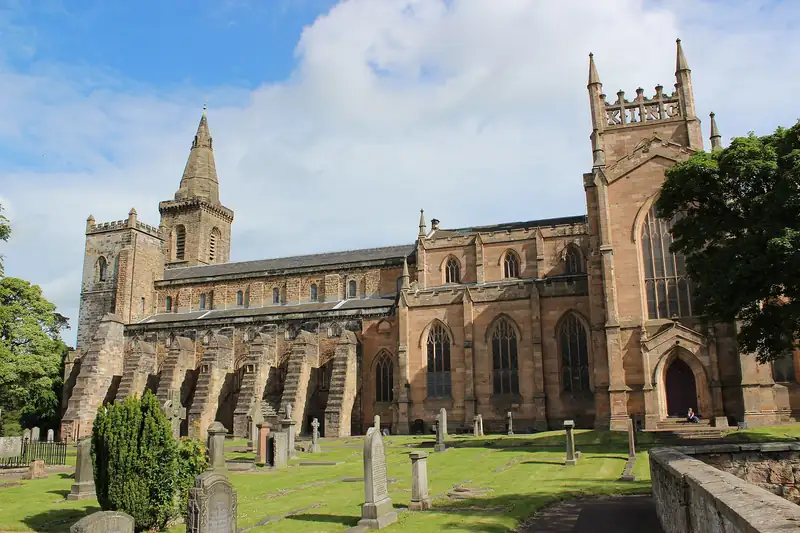
You’ll want the nave if you’ve come to feel how old this place really is. Historic Environment Scotland calls it the most visually stunning example of Romanesque architecture in Scotland, and it sits at the heart of the Heritage Quarter, a short walk from the High Street and Pittencrieff Park. This is the roofed remnant of the great abbey church begun by David I in 1128 and consecrated in 1150, and it’s still the building most people picture when they say they’re going to Dunfermline Abbey.
The story starts earlier than the stone you see. Around 1070, Queen Margaret founded a Benedictine priory here, on the site where she had married Malcolm III, and brought a small community of monks from Canterbury — the first Benedictine house in Scotland, according to Historic Environment Scotland. Their son David I raised that priory to an abbey in 1128, endowed it richly, and, the official history says, brought stonemasons from Durham Cathedral to build on a grand scale. The listing describes a well-preserved 12th-century nave of seven bays, with groin-vaulted aisles and massive circular piers; two of those piers are carved with spirals and chevrons that echo the cathedral going up at Durham at about the same time.
Look up and around as you go in. The west doorway is richly carved, stepped forward in several orders, with chevron ornament and an outer ring of grotesque heads. The west end and towers were rebuilt around 1400; the south tower was rebuilt by William Stark in 1811, and prominent flying buttresses were added to the aisle walls in the 1620s. Inside, Historic Environment Scotland notes early funerary monuments, and the official visit page points you to stained glass, including a window with portraits of Robert I and St Margaret, alongside Malcolm Canmore and William Wallace. Light levels in the nave can be low, and the floor is historic stone slabs, so give your eyes a moment and watch your step.
This was a royal church as much as a monastic one. Historic Environment Scotland describes the choir and crossing — now under the parish church of 1818–21 — as the most important of Scotland’s royal burial places. Margaret, later canonised as St Margaret, David I and Robert I were all laid to rest here. After Edward I badly damaged the abbey in 1303, Robert I financed its rebuilding; the monks’ refectory, rebuilt around 1329, still stands to full height and is one of the most impressive surviving monastic buildings on the site. Robert I was interred before the high altar in 1329; his heart was taken on crusade and later buried at Melrose Abbey. After the Reformation in 1560 the nave became the burgh’s parish kirk, while the old choir was allowed to collapse. Excavations in 1916, beneath the nave floor, found the foundations of earlier church buildings — Historic Environment Scotland says the first church was about 26 metres long, with a west tower, nave and an eastern apse.
A few practical things will save you a wasted trip. Historic Environment Scotland looks after the nave and grounds; the Abbey Church next door is a working Church of Scotland church, so hours can change for services and events, and that can affect access to Robert I’s tomb. Entry is free, and donations are welcome. Seasonal opening times, last entry and the Christmas to early January closure are on the official plan-your-visit page — check it before you set out, and don’t rely on a one-off date. There’s no visitor car park and no visitor toilets on site; Historic Environment Scotland notes on-street parking about 100 metres from the nave entrance, and toilets, including a Changing Places toilet, 100 metres away at Carnegie Library. The nave is usually reached through the graveyard, with three steep stone steps at the door; if you need level access, contact them in advance. The site is about 0.2 miles from the bus station and 0.5 miles from Dunfermline City station. Assistance dogs are welcome. The palace ruins next door have been closed for conservation work, so check the official page for what you can walk through on the day.
| 1 April to 30 September | Daily, 10am to 4.30pm |
|---|---|
| 1 October to 31 March | Tuesday to Saturday, 10am to 4pm (closed Sunday and Monday) |
Free; donations welcome. Last entry 30 minutes before closing in summer, 45 minutes in winter. Closed 25 December to 4 January. The Abbey Church is a working church, so hours can change for services and events.
As published by historicenvironment.scot (opens in a new tab). Check before you go.
Parish Church · 40 m away
Royal Palace Ruin · 40 m away
Townhouse · 100 m away
Town Hall · 100 m away
Local updates, service changes and what’s on — for people who live here, work here or are just visiting. Unsubscribe anytime.