The Nether Yett
Medieval Gateway · 50 m away
The weaver’s cottage where Andrew Carnegie was born, with a memorial hall built by his widow.
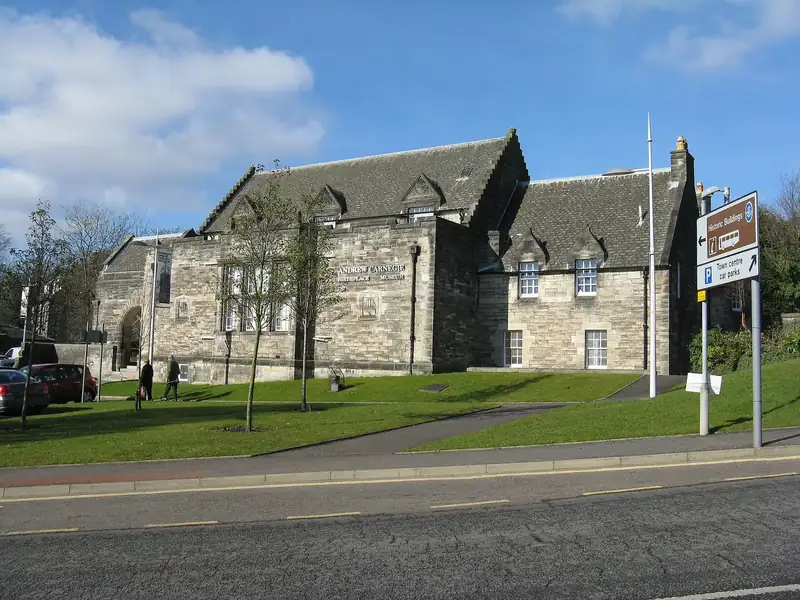
If you want to understand why Dunfermline is full of Carnegie buildings, start here, in the weaver’s cottage where he was born. The Andrew Carnegie Birthplace Museum stands on Moodie Street, just below the Abbey, and it joins that small house to a memorial hall built by his widow. Entry is free; the museum asks for donations, which it says go to its work. It’s one of the simplest, most telling visits in the Heritage Quarter, whether you live here or you’re only in town for the day.
Andrew Carnegie was born in the cottage on 25 November 1835. The museum says the weaver’s cottage was built around 1750; Historic Environment Scotland describes the original birthplace and the adjoining cottage as probably late 18th century. According to the museum, William Carnegie and his wife Margaret (née Morrison) rented one half of the cottage in 1834 from the Templeman family, William’s uncle. The family emigrated to America in 1848. The museum’s own introduction follows the arc from those rooms to Pittsburgh, to great wealth, and to giving away, as the museum puts it, 90 per cent of his personal fortune — including support for places such as Carnegie Hall in New York, the Peace Palace in The Hague and the Mount Wilson Observatory.
The reason the cottage survives relatively unaltered is Louise Carnegie. Historic Environment Scotland records that she bought the cottage and its neighbours in 1895, and that the Moodie Street and Priory Lane properties were transferred to the Carnegie Dunfermline Trustees in 1910. The museum adds that she used a legacy from her grandfather, asked the Trust to look after the cottage after 1903, and that it opened to the public in 1908. Its visitors’ book, still in the collection, records Carnegie’s own first return in 1909: “First visit to my birthplace. The humble home of honest poverty. Best heritage when one has a heroine for a mother.” After his death she proposed a museum hall “to inspire future generations to follow in his footsteps”. James Shearer designed it in 1925–28, in a 17th-century Scottish baronial manner, and the linked cottage and hall were formally opened on 28 June 1928. The opening began with a granite drinking fountain at the entrance, a gift from Carnegie’s grandchildren. The west gable of the hall is inscribed 1835–1919; a porch carries the words “the gods send bread for a web begun”.
The visit is set out as a story in order. The museum says the route begins in the cottage and continues into the hall, running from childhood to legacy. Because the cottage is small, it estimates you may spend up to 15 minutes there; there’s no time limit in the hall during opening hours. Displays cover life in 19th-century Dunfermline, emigration, the American business career, and the later philanthropy. During the Second World War, the museum says, the collections were stored in vaults in the ruins of the abbey fratery, though the building itself stayed open; a major upgrade followed in 2008. Temporary exhibitions change, so check what’s on rather than assuming a particular show will still be there.
A few practical notes will help. The museum publishes opening times of 11am to 4pm, seven days a week, with last entry at 3.20pm, and it also announces a winter closure — currently from 14 December 2026 until 15 March 2027 — so always check before you go. There’s a Fife Council pay-and-display car park next door. Toilets include baby changing. There’s a shop, and the museum’s FAQ says you can bring your own drinks and snacks for the garden or café area; it doesn’t have a cloakroom or bag store. Group and school visits can be booked, but the museum asks larger groups to split for the cottage. Moodie Street is a short walk from the Abbey and from the lower glen entrance to Pittencrieff Park, so it’s easy to take in as part of a wider circuit of the Heritage Quarter.
| Monday to Sunday | 11am to 4pm (last entry 3.20pm) |
|---|
Free. The museum says it is closed from Monday 14 December 2026 and reopens on Monday 15 March 2027.
As published by carnegiebirthplace.com (opens in a new tab). Check before you go.
Medieval Gateway · 50 m away
Royal Palace Ruin · 240 m away
Parish Church · 260 m away
Library · 260 m away
Local updates, service changes and what’s on — for people who live here, work here or are just visiting. Unsubscribe anytime.