Pittencrieff Park
Pittencrieff Street, Dunfermline, KY12 8QH
The estate Andrew Carnegie bought in 1902 and gave to the town as a public park in 1903.
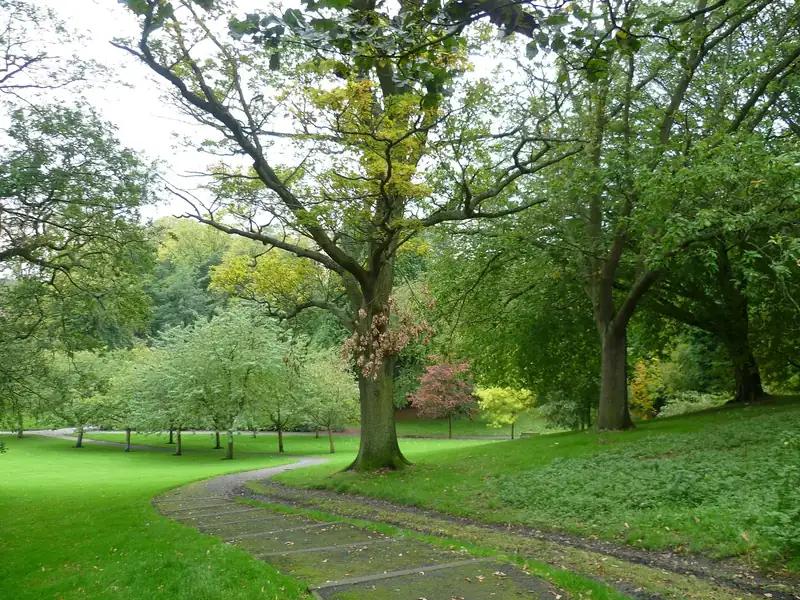
If you live here, you already know it as the Glen; if you’re visiting, this is the park you’ll be pointed to. Pittencrieff Park is the 76-acre estate Andrew Carnegie bought and gave to the town in 1903, immediately west of the city centre, with the Abbey and Palace ruins as a backdrop. Fife Council says it draws more than 750,000 visits a year and is well known for its resident peacocks. Historic Environment Scotland’s inventory rates its historical value as outstanding for those Carnegie associations, and notes design work by Patrick Geddes, Thomas Mawson and Robert Lorimer.
The gift has a sharp local story behind it. Carnegie was born in Dunfermline in 1835; his family emigrated to America in 1848. The inventory records that James Hunt, who owned the estate in the later 19th century, refused public access to the historic features in the grounds, and that Carnegie’s maternal relatives, the Morrisons, were banned even on the one day a year the park was open. They took the case to the House of Lords in 1862 and won. Carnegie later bought the park from Colonel James Maitland Hunt and, in 1903, gifted it with a large endowment to set up the Carnegie Dunfermline Trust. Historic Environment Scotland quotes him calling it “the most soul-satisfying public gift I ever made, or ever can make”.
The landscape you walk through is older than the public park. The Tower Burn cuts a steep wooded glen down the eastern side, looping around the site of Malcolm Canmore’s Tower. The inventory derives the name Dunfermline from “the fort on the crooked burn”, and notes suggestions that the burn was diverted as a moat and that the glen was deepened by early coalmining by the monks of the abbey. In 1903 the Trust asked Mawson and Geddes to prepare plans; both were acknowledged and then shelved, and the park was laid out by James Whitton, superintendent of Glasgow Botanic Gardens, with later work that did take up some of their ideas, including restoration of the glen. In 1976, Historic Environment Scotland records, the Trust handed management to the district council, remaining the formal owner. Fife Council manages the park today.
There’s a lot packed into a walk. Fife Council lists the historical features as Pittencrieff House, the Glen Pavilion, the Double Bridge, the Andrew Carnegie statue, the Louise Carnegie Gates, Malcolm Canmore’s Tower, Wallace’s Well and the dovecot. The formal entrance is the Louise Carnegie Gates at the foot of the High Street; other ways in include Pittencrieff Street, Nethertown Broad Street, St Catherine’s Wynd, Moodie Street and St Margaret’s Street, the last two leading into the lower glen. There are three play areas — two between the Pittencrieff Street entrance and the Glen Pavilion, and one at Nethertown — and the one near the Pittencrieff entrance was opened by the Queen in June 2003. The Laird’s Garden, rock garden and Japanese garden, with a 1906 summerhouse, are part of the designed landscape. The glasshouses are a gap to check: Fife Council currently says they are closed to the public because of safety concerns.
It’s an easy park to use. Fife Council says it is open all year, 24 hours. There’s free parking at the main Pittencrieff Street car park (use KY12 8QH), with limited parking and disabled spaces behind the Glen Pavilion, and coach parking in the main car park. Bikes may use the paths, though there’s no designated bike parking inside the park. Buses stop on Moodie Street and Pittencrieff Street, and the bus station is about a five-minute walk from the Louise Carnegie Gates. The nearest railway station is about half a mile from the Nethertown entrance — a ten-minute walk, according to the council. Public toilets are by the Lily Pond, officially open 9am to 5pm, with an accessible toilet (RADAR key), baby changing and a defibrillator; they’re closed on 25 and 26 December and on 1 and 2 January. It’s a park for a short shortcut as much as for a long afternoon — just don’t plan on the glasshouses until the council says they’re open again.
No opening or access information is published for this place by an official source, so we don’t give any. Many listed buildings are private homes or businesses.
Pittencrieff Street, Dunfermline, KY12 8QH
Pavilion · 10 m away
Bridge · 160 m away
Laird’s House · 170 m away
Tower Remains · 220 m away
Local updates, service changes and what’s on — for people who live here, work here or are just visiting. Unsubscribe anytime.