Pittencrieff Park
Pittencrieff Street, Dunfermline, KY12 8QH
The foundations of a tower traditionally said to be Malcolm III’s residence, on a crag above the Tower Burn.
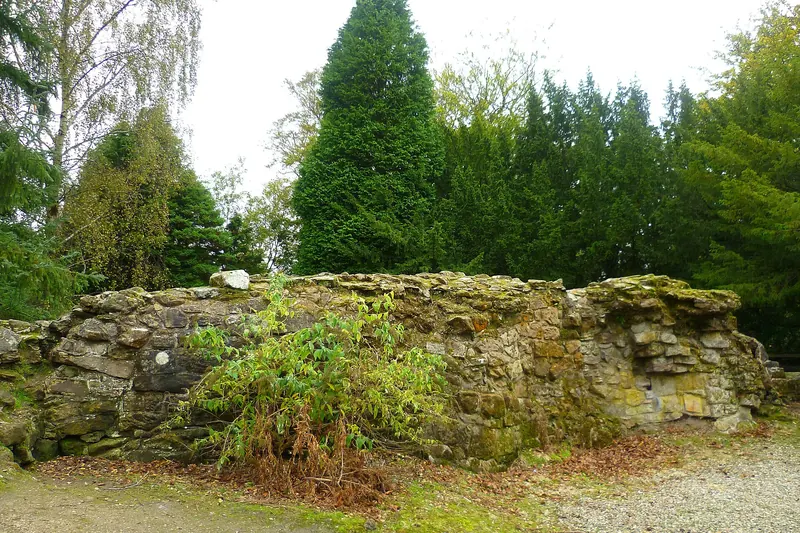
You’ll come up here for the idea as much as for the masonry. Malcolm Canmore’s Tower is a low L-shaped foundation on a crag in Pittencrieff Park, above the Tower Burn, traditionally said to be the residence of Malcolm III. Historic Environment Scotland is careful about that: the site is thought to have been his, and it is associated in the national consciousness with early Scottish royalty and the founding of the royal burgh, but “these links cannot as yet be confirmed.” What you stand on is still one of the most charged spots in the Glen — a small, scheduled ruin with a very large story attached.
The visible remains are modest, and that’s part of the point. Historic Environment Scotland describes rubble foundations enclosed by a modern oval wall about a metre high. Only an L-shaped stretch survives, measuring 13 metres north–south by 4 metres east–west, with foundations between 2 and 4 metres thick. The facing stones have gone, so the character of the building is hard to read; the masonry may be of the 12th or 13th century. The site has been excavated on and off since Victorian times, and much of it has been stripped down to bedrock, then consolidated. The scheduled area is a small oval, and the modern boundary wall is excluded from the scheduling. Don’t expect a standing keep: this is a ground plan you have to imagine back into three dimensions.
Tradition has done a lot of the work that the stones no longer can. Dunfermline’s coat of arms shows a round tower with a crenellated parapet, traditionally said to represent this one, between two lions rampant. Historic Environment Scotland’s inventory of Pittencrieff Park notes that the Tower Burn flows through the glen and around the “ancient fortress”, and that the name Dunfermline is derived from “the fort on the crooked burn”. It has been suggested, the same record says, that the burn was diverted around the fortress to form a moat, and that the glen was artificially deepened by early coalmining of the monks of Dunfermline Abbey. The inventory also records a popular tradition that the site was Macbeth’s stronghold before Malcolm’s time. Treat those as traditions and suggestions, not as settled archaeology: the official scheduling is frank that the royal link is still unproven, which is why the place is as interesting as it is.
The setting does as much as the monument. The tower stands on Tower Hill, just north of Pittencrieff House, in the park Carnegie gave to the town in 1903. From here the Abbey and Palace sit close by to the east; the burn loops below. Fife Council lists Malcolm Canmore’s Tower among the park’s historical features, alongside the house, the Double Bridge, the Louise Carnegie Gates and the dovecot. The inventory calls the remains a prominent part of the designed landscape. Come up through the park rather than treating this as a separate expedition: the Glen’s paths, the views over the burn, and the palace façade on the far side are all part of the same walk.
Practically, it’s straightforward. The park is open all year, 24 hours, according to Fife Council, and the tower is one of the historic stops on its exploring pages. Entrances from St Margaret’s Street and Moodie Street lead into the lower glen; the formal Louise Carnegie Gates and the Pittencrieff Street car park (free, KY12 8QH) are other easy ways in. Public toilets are by the Lily Pond. Because this is a scheduled monument of national importance, the remains are legally protected: look, take in the view, and leave the masonry as you find it. If you want the documented royal story in standing buildings rather than in foundations, the Abbey nave and Abbey Church are only a short walk up the slope — and Historic Environment Scotland is clear that the unconfirmed tradition here and the royal burials there are not the same kind of evidence.
No opening or access information is published for this place by an official source, so we don’t give any. Many listed buildings are private homes or businesses.
Pittencrieff Street, Dunfermline, KY12 8QH
Bridge · 60 m away
Laird’s House · 100 m away
Gateway · 130 m away
Statue · 150 m away
Local updates, service changes and what’s on — for people who live here, work here or are just visiting. Unsubscribe anytime.