Carnegie Baths (Carnegie Leisure Centre)
Public Baths · 90 m away
An extensive weaving factory with an Italianate frontage, on the site of Dunfermline’s first steam-powered weaving factory.
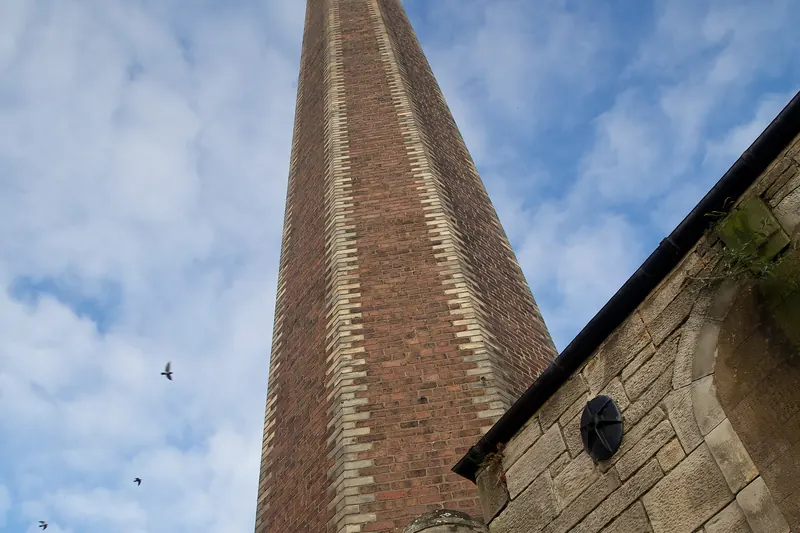
Pilmuir Works is the big Italianate factory front on Pilmuir Street, and it’s one of the most important industrial buildings left in the town. Historic Environment Scotland lists the complex at Category A: an extensive linen damask factory, with a 28-bay, three-storey office and warehouse block by T. Hyslop Ure, 1883–1901, weaving sheds to the west, and a polychromatic octagonal brick chimney on Cousins Lane. A pediment is inscribed “Estd 1849.” It stands on a site HES thinks was already industrial in 1816, and where Mr Scott is thought to have started Dunfermline’s first steam-powered weaving factory in 1847.
The business failed and was restarted two years later by Andrew and Henry Reid. By 1860 there were 200 looms here, second only to St Leonard’s Works. By 1913 there were 700. Hay and Robertson bought it in 1926 after a fire at their Caledonia Works, and Dunlop acquired it in 1947 to weave tyre fabric. When HES updated the record in 1999, it was the only working weaving shed in Dunfermline and the oldest in Scotland — that was the position then, not a claim about today. The listing also notes a kiln in the handloom factory as the only example then recorded.
The street front is the public face: regularly fenestrated sandstone, pavilion blocks, and, HES says, a lavish oak-panelled suite of managerial offices with stained glass. Current use of the works is not something to take from a 1999 list description. There are no official visitor hours on the heritage record, and large historic factories are often in other uses or in development. Look at it from Pilmuir Street, Foundry Street and Cousins Lane as a monument of the damask trade that paid for so much of Victorian Dunfermline, and leave the interiors unless an official project invites you in.
No opening or access information is published for this place by an official source, so we don’t give any. Many listed buildings are private homes or businesses.
Public Baths · 90 m away
Clinic · 120 m away
Former Church and Statue · 230 m away
Shrine Cave · 290 m away
Local updates, service changes and what’s on — for people who live here, work here or are just visiting. Unsubscribe anytime.